Start with one agent
Multi agent diagrams look good on slides. A planner, a researcher, a writer, a critic, each in its own box, passing work along arrows.
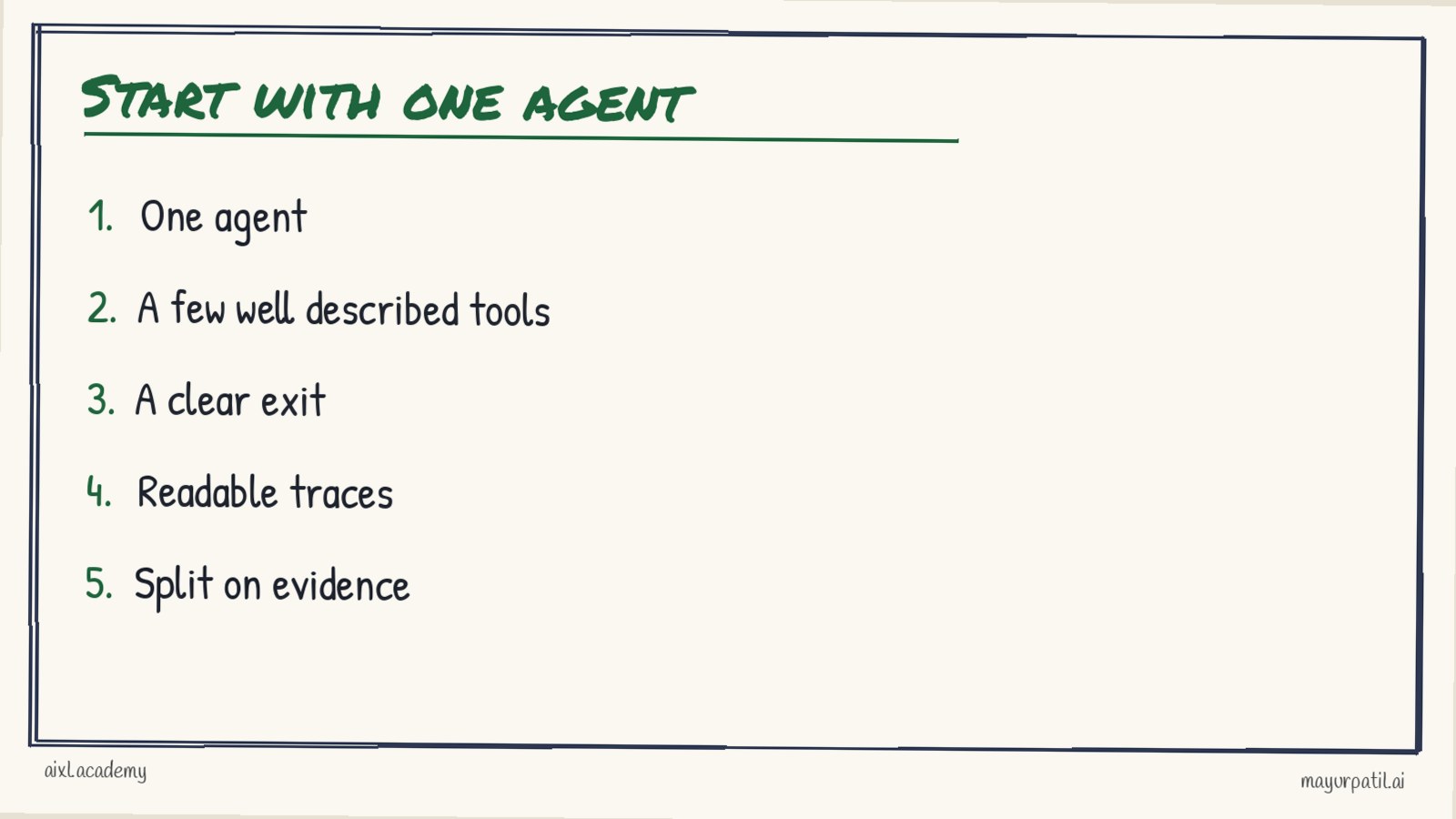
Hand-written diagram: start with one agent, a few tools, a clear exit, readable traces, split only on evidence
In production, most of the multi agent systems I have reviewed should have been one agent. This article is my default design, and the cases where I do split.
What each handoff costs
Every time work passes from one agent to another, three things happen.
Context is lost. The second agent sees a summary, not everything the first agent saw. Small details that mattered get dropped.
Cost goes up. Each agent has its own instructions and often re reads the same material. Calls multiply.
Debugging gets harder. When the final answer is wrong, you have to find which agent made the mistake and why, across several traces.
None of these are reasons never to split. They are the price of a split, and the price should buy something.
My default
One agent. One set of instructions, written for the task.
A few well described tools. Each tool has a clear name, a description of when to use it and a strict input and output contract. Overlapping tools confuse the model, so I merge or remove them.
A clear exit. The agent knows what done looks like, and code checks it. There is a cap on turns and a defined way to stop and hand to a person.
Readable traces. A person can read one run end to end and understand every decision.
This design handles more than people expect. Many workflows that were drawn as five agents are one agent calling five tools.
When I split
I split when the evals show a specific problem a single agent can not solve. The common ones:
- Two tasks need very different instructions and keep interfering. For example, strict extraction and friendly drafting in one context.
- A task needs a tool set that would be unsafe to give the main agent. A separate agent with narrow permissions is easier to control.
- A sub task is long and would crowd the main context. A specialist does it and returns a short, checked result.
Even then, I keep it small. A coordinator and one specialist. The contract between them is as strict as any API, and the eval set covers the handoff.
How to decide
Build the single agent first and run the eval set. Look at the failures. If they point at a cause a split would fix, split that part and run the evals again. If quality and cost both improve, keep it.
If you can not point at the failure the split fixes, do not split.
A short checklist
- Start with one agent and a few clear tools.
- Write the exit condition before the instructions.
- Make traces readable by a person.
- Split only to fix a failure the evals show.
- Treat the contract between agents like an API, and test it.
Simple systems are easier to run, cheaper to operate and easier to hand over. Earn the complexity.
Common questions
Is a multi agent system better than a single agent?
Not by default. Each handoff loses context and adds cost and debugging effort. Split when evals show a specific problem one agent can not solve.
When does splitting help?
When two tasks need very different instructions or tools and keep interfering in one context.
How many tools should one agent have?
As few as the task needs, each with a clear description and contract. A long list of overlapping tools confuses the model.
How do you decide?
Run the eval set on the single agent first. Split only to fix a failure you can point at.