Write the evals before the demo
A demo tells you an AI system can be right. An eval tells you how often it is right, and on which cases it fails.
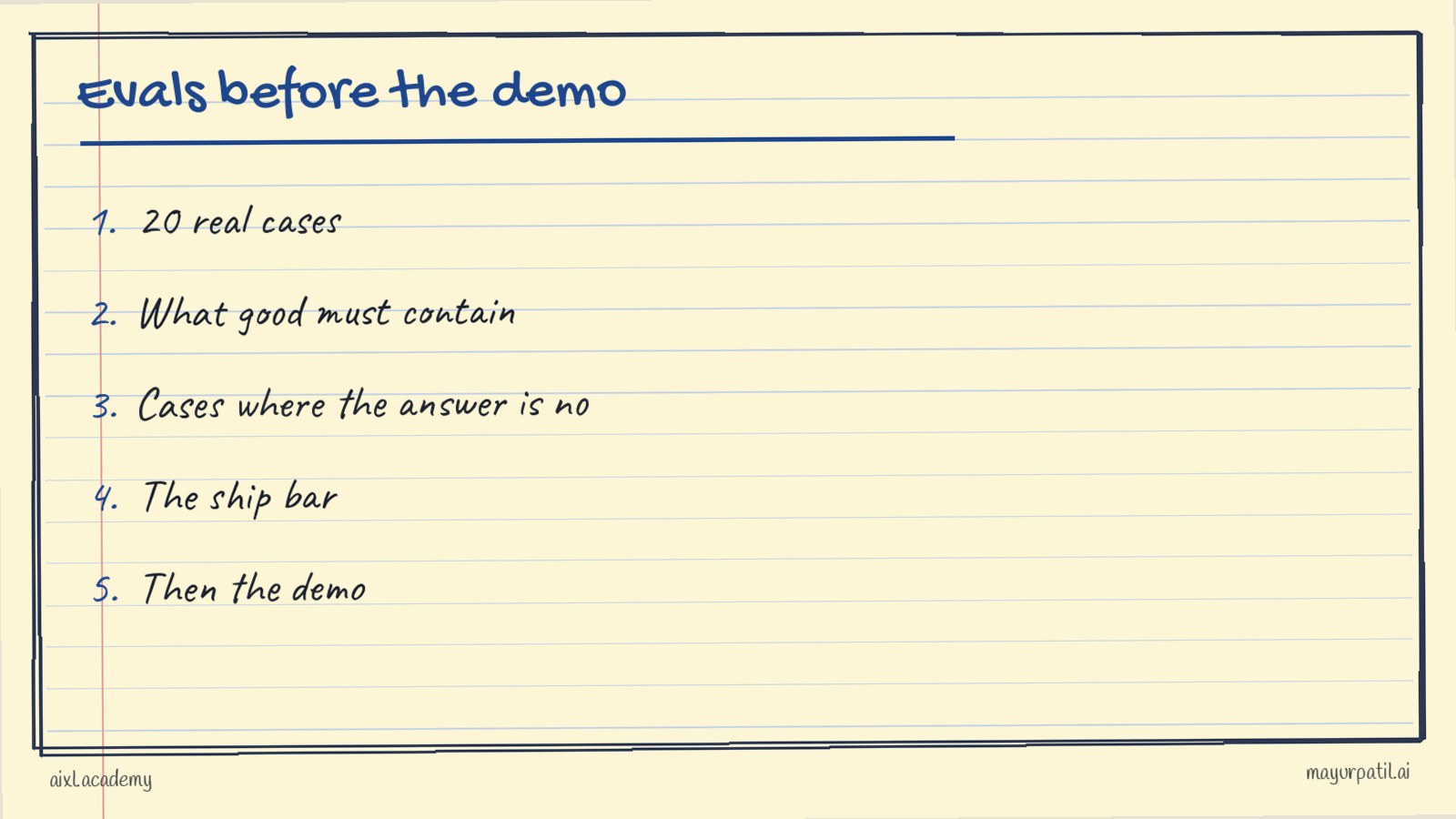
Hand-written diagram: evals before the demo, real cases, what good contains, refusal cases, ship bar, then the demo
On most enterprise projects I see, the order is the other way round. The demo comes first, everyone likes it, and the evals are planned for later. Later usually means the week after the first real user complains.
I now write the evals before the demo. This article is how I do it, and why it saves time rather than costing it.
The problem with demo first
A demo is chosen by the person who built it. Without meaning to, they pick inputs that work. The business sees a system that answers well and assumes it answers well in general.
Then real users arrive with real inputs. Long emails, half filled forms, questions in two languages, requests the system should refuse. The misses start, and with them the argument: is the assistant good enough or not?
That argument has no end, because nobody wrote down what good enough means. Engineering points at the accuracy they measured on their own tests. The business points at the three bad answers their manager forwarded. Both are right, and the project stalls.
What I write first
Before any demo, I sit with the people who will use the system and collect about twenty real cases. Not invented ones. Real inputs from tickets, emails and documents they handled last month.
For each case we write:
- The input, exactly as it arrived.
- What a good answer must contain, in the words of the user. "Mentions the approval limit." "Points to the correct form." "Does not promise a date."
- What a good answer must not do. Invent a policy, quote a document the user can not open, take an action without approval.
Then we add a few cases where the right answer is no. "I do not know." "This needs a person." "That is outside what I can do." In my experience these cases find more problems than any others, because models want to answer everything.
Finally, we agree the ship bar. What score means do not ship? Which cases are critical, where a single failure blocks release? The owner of the system signs this, in the same document as the success metric.
This takes two or three days. Most of it is conversation, not engineering.
Turning cases into checks
Some checks are simple. Does the answer contain the approval limit? Is the output valid against the schema? Did the agent call the approval tool before the payment tool? These run as code.
Some need judgement. Is the tone right? Is the explanation correct? For those I use a written rubric, graded by a person first and later by a model judge once the judge agrees with people on a sample. The rubric is the real work. A vague line like "is helpful" will produce noise whoever grades it.
Then the demo
The demo still happens. It happens against the eval set, in front of the business, and the misses are shown too.
This changes the conversation. Instead of "it looks good" or "it got my question wrong", people say "case 14 fails, is that critical?" The argument about good enough already happened, on paper, before the build. Now it is a list of cases to fix.
How the set grows
The first set is small on purpose. It grows from three places:
- Every bug found in testing becomes a case.
- Every action a person rejects at an approval step becomes a case.
- Every production ticket becomes a case once the system is live.
Within a month, a set of twenty is usually closer to a hundred, and every case in it came from something real.
Why this is faster
Writing evals first feels slower in week one. It is faster by week four, for three reasons.
Changes become safe. A prompt change, a new model, a new retrieval setting: run the set, compare, decide. Without it, every change is a debate.
Scope stays honest. If a case can not be written down, the requirement is not clear yet, and it is better to find that before building.
Handover works. The eval set is the most useful thing a new owner inherits, because it lets them keep the system honest after the build team leaves.
A short checklist
- Twenty real cases, collected with the users.
- What good must contain and must not do, for each.
- A few cases where the right answer is no.
- A ship bar and a list of critical cases, signed by the owner.
- The demo run against the set, misses shown.
If you can only do one thing differently on your next AI project, do this one.
Common questions
How many cases does a first eval set need?
About twenty real cases is enough to start. It grows from bugs, rejected actions and production tickets.
Who writes the expected answers?
The people who will use the system, in their own words. Engineers help turn them into checks.
Should the eval set include refusals?
Yes. Cases where the right answer is "I do not know" or "this needs a person" find many problems, because models want to answer everything.
When is the demo shown?
After the eval set exists, and it is run against those cases in front of the business, misses included.
Next in this series: Evals as experiments: what a result can and cannot claim.