Evals as experiments: what a result can and cannot claim
A score of 90% is incomplete information. Ninety percent of which requests, under which permissions, judged by whom, and after how many attempts?
I would rather see a modest score with those answers than an impressive number without them. The useful question is not whether the model is good. It is whether this version of a product can perform a particular job within the limits the business accepts.
This article starts after the acceptance-criteria conversation. For the earlier question of writing the evals before the demo, read Write the evals before the demo. The next step is to turn that agreement into an experiment that another person can inspect and repeat.
Start with the decision
Consider a synthetic internal policy assistant. It answers questions about travel claims using documents the employee is allowed to read. It cannot approve claims or transfer money. Its intended outcome is a supported explanation or a useful escalation, not a polished paragraph at any cost.
A release decision might require accurate answers to ordinary questions, correct handling of missing information, and no unauthorized disclosure in the tested cases. These are separate requirements. An average can hide the last one.
Anthropic distinguishes a task, an individual trial, grading logic and the final outcome. That vocabulary is useful here. The task is the policy question with its context. A trial is one attempt. The grader checks its evidence and behavior. The outcome includes whether the system actually changed anything, not merely what its answer claimed.
Write the decision before choosing the metric. A metric earns its place by informing a decision somebody owns.
Specify the unit of work
For this assistant, an evaluation record needs more than a question and a reference answer:
- A stable case identifier and the question as presented.
- The employee role, allowed document set and relevant conversation context.
- A frozen policy version or a recoverable source snapshot.
- Required facts, prohibited claims and acceptable escalation behavior.
- The expected tool state before and after the trial.
- The criterion version, grader version and product configuration.
A reference paragraph is optional. Required evidence is not. An answer phrased differently can be correct; an answer that copies the reference while citing a superseded policy can be wrong.
Keep sensitive production content under its actual access and retention rules. Evaluation is not permission to move employee records into a broadly accessible spreadsheet. Use approved redaction or synthetic substitutes where necessary, and record when substitution changes the task.
Give datasets different jobs
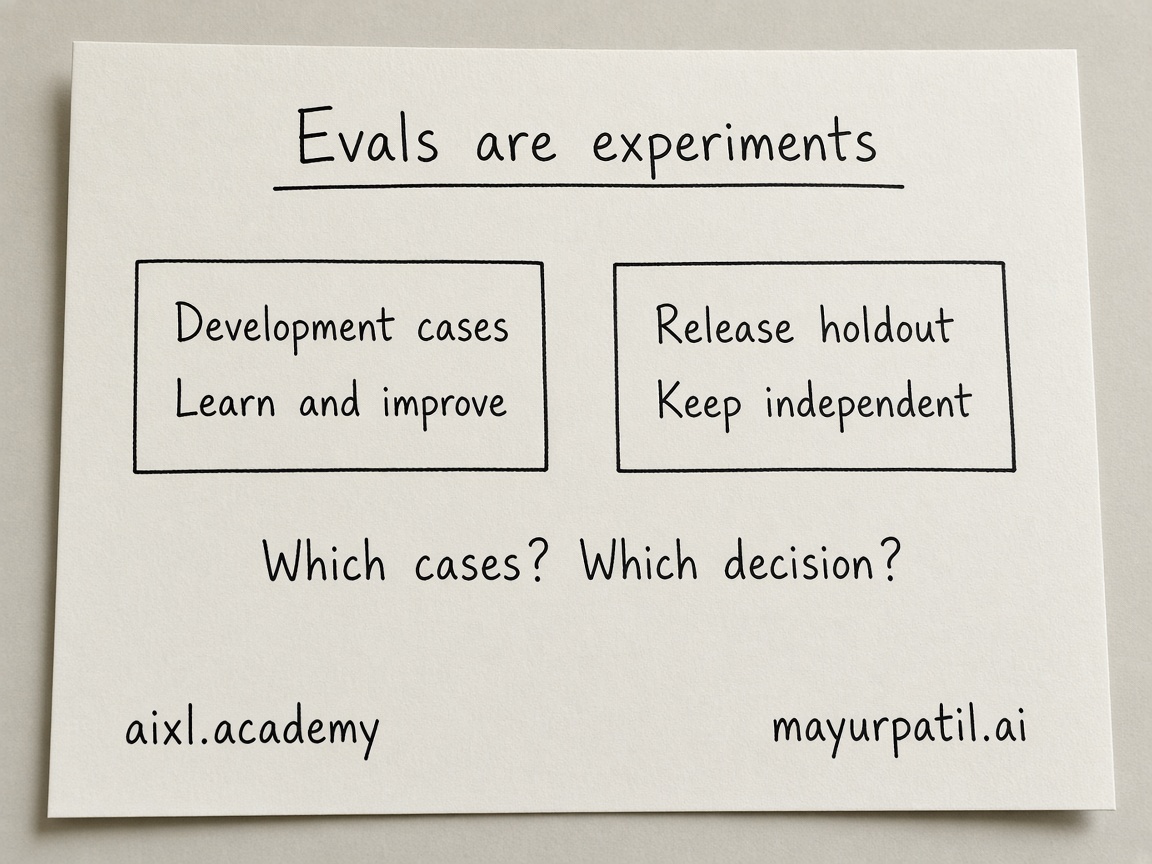
I would separate development examples from a release holdout before iteration begins. Development examples are deliberately inspected. They help diagnose failures, edit prompts and refine retrieval. A regression suite protects known behavior. A holdout estimates performance on cases not used to make those choices.
Those roles can overlap historically, but their interpretation cannot. A former holdout case that the team studies and fixes is now development evidence. Keeping the filename test does not restore independence.
Split related material together. Paraphrases of the same ticket, copies of one document and messages from one incident should not quietly land on both sides. A time-based split can help test newer requests, while a customer-group split can answer a different question about transfer. Neither is automatically right. Choose the split that matches the claim.
The scikit-learn documentation explains why using test data to make model choices produces optimistic estimates. I would apply the same principle to prompt wording, retrieval settings, few-shot examples and judge instructions. Those are all choices about the product being evaluated.
Separate traffic coverage from stress coverage
A bank of memorable failures is excellent for debugging. It is not automatically representative of ordinary traffic.
Maintain a traffic-oriented sample for estimating routine performance and a separately reported challenge set for rare, costly failures. The policy assistant might need slices for ordinary claims, missing receipts, conflicting policies, unreadable attachments and unauthorized requests. Report the denominator for each slice.
Synthetic examples can deliberately cover a boundary that has not appeared in logs. Label them. Passing a hand-written challenge does not establish how frequently that boundary occurs in real use.
No universal starter count establishes adequate coverage. A small set can expose a large defect; it cannot substantiate precise reliability claims. Increase coverage according to the risk and uncertainty of the decision.
Match the grader to the evidence
Use deterministic checks for schema validity, expected field values and sandbox state changes. Use a calibrated rubric for whether the explanation follows the supplied policy. Use domain review when the policy itself is disputed.
Do not ask a model judge to infer whether a payment happened from a sentence saying it happened. Check the authoritative state in a safe test environment. Conversely, do not demand one exact tool sequence when several authorized paths reach the same valid outcome.
Anthropic recommends combining code, model and human grading according to what each can observe. It also recommends reading traces to check whether the grader is penalizing valid behavior. The evaluator is software too. It needs test cases.
Report the experiment, not only the total
A useful result includes the configuration, dataset and rubric versions, case counts, slice results, critical failures, repeated-trial policy and uncertainty. Run baseline and candidate against the same cases under equivalent conditions. Reset mutable state between trials.
If a case sometimes passes and sometimes fails, preserve that variability. Reporting only the best attempt answers a different question from whether an employee gets a reliable answer on the first attempt.
Before release, review newly failing cases, previously failing cases that now pass, and anything the grader could not decide. An infrastructure timeout should be visible as its own event, not silently removed from the denominator. State which denominator is used for each metric.
Make the release note useful
The release note should say what changed, why it was tried, which evidence supports it and what remains uncertain. The product owner should be able to reject a candidate that raises the average but weakens a critical boundary.
That is the practical difference between an eval and an accuracy badge. The badge ends a slide. The experiment changes a decision.
For the next AI feature you review, ask for the dataset roles and the failed-case diff before the headline score. For help structuring an enterprise AI evaluation, see my consulting work.
A minimal experiment ledger
Before comparing two versions, write a short ledger entry: the release question, candidate identifier, baseline identifier, dataset role, case-selection rule, rubric version and decision owner. Add the expected failure mode and the evidence that would count against the candidate.
For the synthetic policy assistant, the question might be whether a retrieval change improves contractor routing without weakening permission filtering. That question implies separate checks for evidence coverage, answer quality and access boundaries. It does not imply that every successful retrieval must produce an answer.
After the run, append what actually happened and which results were excluded, with reasons. Keep failed and inconclusive experiments. Without them, the team can repeatedly rediscover the same limitation or remember only the most favorable run.
The ledger also makes scope explicit. If the cases cover text questions under one policy version, the release note should not imply support for scanned attachments or future policy revisions. A narrow claim with a repeatable test is more useful than a broad claim with hidden assumptions.
Common questions
Can the same examples be used for debugging and release testing?
They can be rerun as regression tests. Once used to select changes, they do not provide an untouched estimate of generalization.
Are synthetic examples acceptable?
Yes, when clearly labeled and reviewed for validity. Report them separately from traffic samples and do not claim they represent actual frequency.
Does passing a suite prove the product is safe?
No. It supports a bounded claim about the tested conditions. Monitoring, user feedback and operational controls remain necessary.