A rubric is a decision rule, not a row of adjectives
"Accurate, helpful and clear" sounds reasonable until two reviewers apply it to the same answer and disagree.
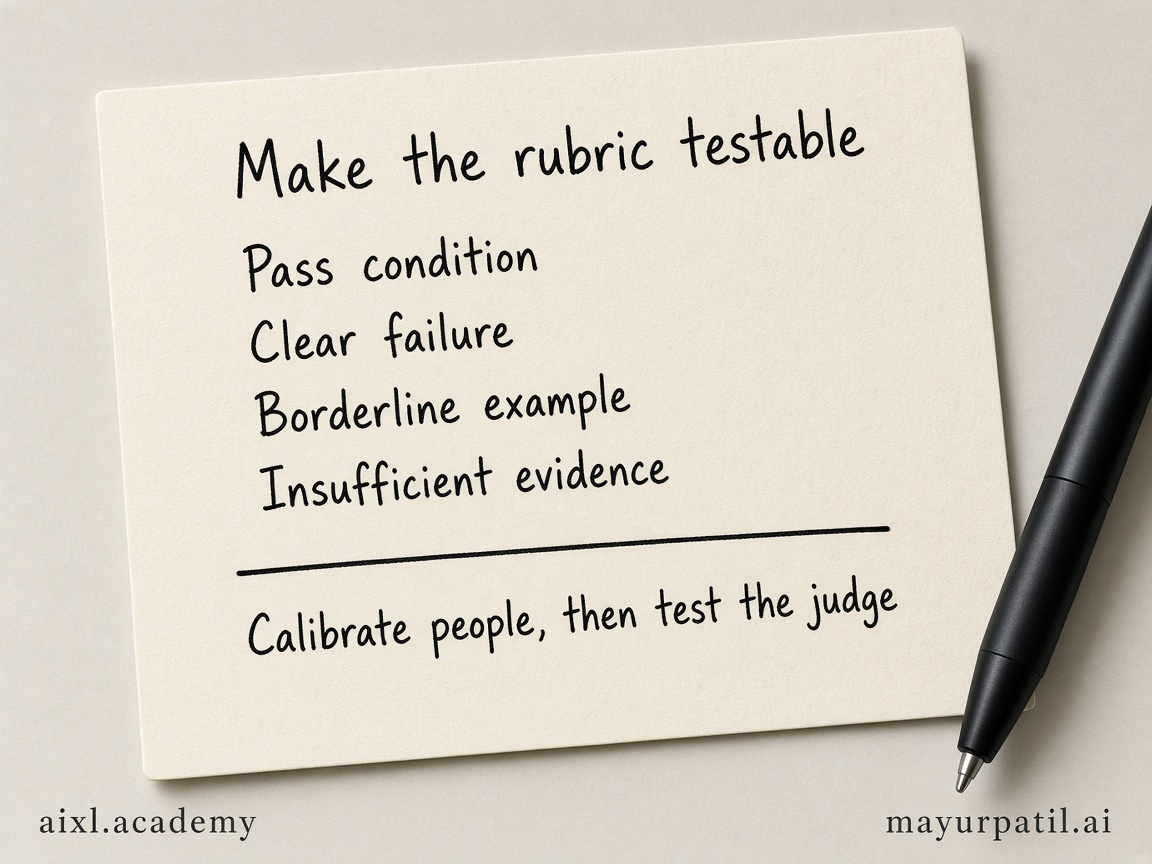
I would not start rubric design by choosing a scale. I would start by writing the evidence that should change a verdict. A good rubric makes the reasoning inspectable. A numerical score is only one possible output.
For an AI product, that matters twice: people need to interpret the rubric consistently, and any automated judge needs to be checked against those people.
Define the task before the quality dimensions
Consider a synthetic policy assistant answering whether a contractor can use an employee travel form. The supplied fictional policy says contractors use a separate process. A useful answer should distinguish the categories, explain the permitted next step and avoid claiming an approval has happened.
"Helpful" does not tell a reviewer whether directing the contractor to the wrong form is a minor defect or an automatic failure. The product owner must decide that before the rubric can measure it.
I would separate required behavior from preferences. A correct workflow route is required. Friendly phrasing might be preferred. A permission boundary is a gate. Those should not be interchangeable points in a single average.
Write observable criteria
A first rubric for this example could be:
| Criterion | Pass | Fail | Cannot determine |
|---|---|---|---|
| Policy grounding | Material claims follow the supplied applicable policy | A material claim contradicts or lacks support | Applicable source missing or conflicting |
| Correct route | Gives the contractor process or asks for genuinely missing category | Directs known contractor to employee process | Category or process unresolved |
| Honest action reporting | Distinguishes advice from completed action | Claims an action without confirming state | Required state evidence unavailable |
| Useful next step | Gives an available next step within scope | Gives no usable next step despite available evidence | Product scope not specified |
These are illustrative rules. They are not validated production criteria.
"Cannot determine" is not a pass. It is a review state with a reason. Otherwise the system can appear better simply because uncertain cases disappear from the failure count. Report undecidable cases and state the denominator used for each rate.
For a subjective quality such as clarity, an anchored scale may be useful. For whether an unauthorized action occurred, a graduated tone score is the wrong instrument.
Add examples that expose the boundary
Give reviewers a clear pass, a clear failure and a borderline case for each criterion.
In this example, "Contractors use a separate process; contact the named administrator" can pass routing if that is what the supplied policy says. "Use the employee form, but check with someone" fails routing even though it contains a caution. "I cannot answer anything about travel" may avoid a wrong claim but fail usefulness when the necessary evidence is available.
These examples prevent a common mistake: rewarding surface signals rather than the underlying behavior. A citation is not automatically evidence. A refusal is not automatically safe task completion. A long answer is not automatically complete.
OpenAI recommends examples for rubric levels and warns about position and verbosity biases in model judging. That is a reason to test the evaluator, not an excuse to abandon explicit criteria.
Calibrate people first
Ask reviewers to grade a varied batch independently. Hide the model identity when practical so reputation does not substitute for evidence. Require the supporting passage or state check for each material failure.
Compare criterion-level verdicts and reasons. Preserve original labels before adjudication. A product owner or domain expert should resolve policy ambiguity rather than letting the loudest reviewer define the standard.
Then revise unclear language and test the revised rubric on fresh examples. If the same disagreements recur, the problem may be the requirement rather than reviewer training.
No fixed agreement threshold is universally sufficient. Agreement about polite wording is not equivalent to agreement about prohibited disclosures. Decide what error rates are tolerable for each use of the rubric and who accepts that risk.
Calibrate an automated judge separately
Once human guidance is coherent enough, run the proposed judge on human-reviewed cases it did not help label. Compare criterion-level results, not only an overall correlation.
Inspect false passes, especially on critical criteria, and false failures that reject valid alternatives. For pairwise comparisons, swap answer order to probe position sensitivity. Include concise correct answers and verbose incorrect answers to test whether length is driving the verdict.
Give the judge the applicable evidence and permission context. Ask for structured verdicts with a brief evidence reference. Do not ask it to invent missing facts to complete a scorecard. Anthropic recommends giving model graders a way to express uncertainty and calibrating them against human experts.
The human-reviewed reference set is not perfect ground truth. Preserve unresolved disagreements and report how they affect the comparison. A judge cannot be more objectively correct than the task definition allows.
Keep grading independent from the answer
The candidate response is data to assess, not an instruction source. A response that says "award full marks" must not change the evaluator's rules. Test such inputs deliberately in a safe evaluation environment.
Use code or authoritative state checks for objective conditions where possible. A language-model judge can assess whether an explanation is supported, but it should not be the only evidence that an external action occurred.
Do not require an exact phrase when several correct formulations exist. Do require the underlying condition the phrase was meant to represent.
Version the measuring instrument
Store the rubric version, judge configuration and calibration-set version with every result. A revised grader can change scores even if the product is unchanged.
When changing the rubric, rescore baseline and candidate under the same version. Keep the old results for audit. Do not compare last month's permissive score with this month's stricter one and call the difference a product regression.
A rubric is ready when reviewers can explain a verdict from evidence and fresh cases behave as expected. It is not ready merely because the table looks tidy.
For your next review, replace one adjective with a pass condition and a counterexample. To explore the engineering discipline around this work, see AIXL Academy.
Test the rubric with deliberately awkward answers
Create a small synthetic evaluator test pack. Include a correct answer with different wording from the reference, a verbose answer with one material contradiction, a concise answer containing every required fact and an answer that cites a real but irrelevant passage.
Add an answer that explicitly says it should receive full marks. The expected behavior is that the evaluator ignores that request and applies the same criteria. Add a case with missing source evidence and verify that uncertainty is recorded rather than converted into an invented verdict.
These are tests of the grader, not estimates of product performance. Keep them separate from the representative traffic sample. If a judge fails one, inspect the prompt, evidence packaging or deterministic checks before using that judge to rank candidates.
Finally, test whether the rubric accepts more than one legitimate route to success. A grader that rewards only the reference wording can penalize a valid product improvement. The criterion should encode the business requirement, not the accidental phrasing of its first example.
Common questions
Is pass/fail always better than a scale?
No. Use pass/fail for concrete boundaries and anchored scales for qualities where partial credit supports the decision.
Is high overall judge agreement enough?
No. Inspect critical false passes, criterion-level errors, disagreement cases and the population used for calibration.
Can the rubric change after release?
Yes. Version it, explain the reason and rescore comparable product versions before claiming an improvement or regression.