Human baselines: compare the workflow, not a mythical expert
"Better than a human" is not a useful product requirement until the human, task and working conditions are defined.
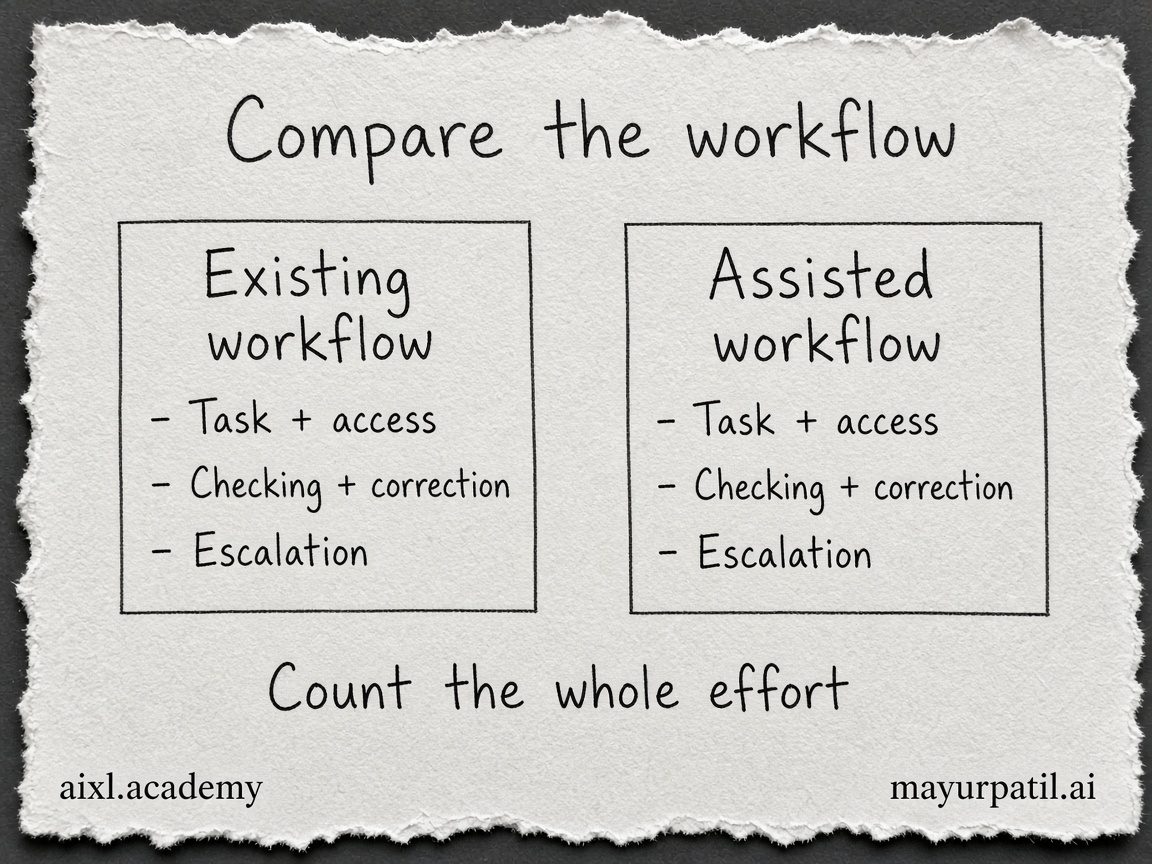
Diagram for Human baselines: compare the workflow, not a mythical expert: approved hand-drawn card
An expert with unlimited time and access to every document is a different baseline from an employee answering a ticket during a normal shift. A person using an AI assistant is a different workflow again.
I would measure those conditions separately. The goal is not to win a contest against people. It is to understand where the product helps, where it needs review and where the work itself is ambiguous.
Separate three human roles
A human reference answer, a human baseline and a human grader are not the same thing.
The reference answer is an example of acceptable work, possibly revised after discussion. The baseline is performance by people actually doing the task under specified conditions. The grader applies the rubric to outputs. One person can participate in several roles, but the study needs to record that overlap.
If the expert who wrote the task also writes a polished reference after seeing every source, that reference is not a measured estimate of routine human performance. Treating it as one creates an unfair comparison before the model runs.
Likewise, grader agreement says something about the evaluation process. It does not by itself establish how well employees perform the task.
Compare the relevant systems
For a synthetic support workflow, I would consider three conditions:
- A person using the approved existing tools without the proposed assistant.
- The proposed assistant acting within its intended scope.
- A person using the assistant with the intended review and escalation process.
The third condition may be the actual product. If every response requires review, evaluating only autonomous answer quality omits part of the system and part of its cost.
Give each condition comparable evidence and permissions. If the assistant can search the policy corpus, the unaided baseline should have its ordinary approved search tools. If the assistant is restricted from a confidential appendix, the human comparison should not silently rely on it.
Comparable does not always mean identical. Record justified differences because those differences affect what the result means.
Define a protocol before collecting outputs
Write the task population, case selection, available tools, time policy and escalation rules in advance. Record reviewer expertise rather than describing every participant as an expert.
Use the same cases for comparisons when appropriate, but avoid learning effects. A person who answers the same case once without assistance and then with the assistant has already learned from the first attempt. Different but matched cases, counterbalanced order or a parallel design may be more appropriate. The choice depends on the question and available participants.
Blind graders to output origin where practical. Randomize presentation order. OpenAI's evaluation guidance describes randomized, blinded human assessment as one option. The detailed study design here is a recommendation, not a claim that one design is universally best.
Keep the test set out of prompt development and participant training. Use separate practice material so people understand the task without rehearsing the measured cases.
Measure quality and effort together
A synthetic comparison might record correctness, unauthorized actions, appropriate escalations, completion time and review time. Do not collapse them into a score before deciding how trade-offs should work.
The AI-assisted workflow can produce a faster draft and still consume more total time if people must verify every assertion. Review effort is part of the product, not an external inconvenience to exclude.
Measure total workflow time explicitly: preparation, generation, review, correction and handoff. Record unresolved cases rather than assigning them invented completion times. If a workflow escalates, measure whether the escalation is appropriate and what happens to the unresolved work.
Cost per completed, acceptable task is usually more decision-relevant than cost per generated paragraph. Define acceptable before calculating it.
Interpret disagreement carefully
Suppose two qualified people give different answers to a policy question. First check whether they saw the same policy version and worker category. Then ask whether the policy allows several valid routes or is genuinely unclear.
The answer is not automatically to force a majority label. Some cases need policy-owner adjudication. Others should accept multiple answers. Still others are outside the current product scope and should be reported as such.
Anthropic advises creating tasks experts can independently pass and checking ambiguous specifications. That principle is important for fair baselines: a task humans cannot reliably interpret is a weak instrument for ranking an AI system.
Human disagreement is not a ceiling on model performance. Nor is one expert's answer infallible. It is evidence about the task and the reference process.
Report a bounded result
Imagine a purely hypothetical table showing the assisted workflow finishing routine cases faster while escalating more exceptions. That does not establish a general productivity improvement. The interpretation depends on the case mix, quality bar, participant population and what happened after escalation.
Report sample sizes, selection, uncertainty and slice results. Separate ordinary cases from difficult exceptions. Do not use a small convenience sample of colleagues to make claims about an entire profession.
If no actual study was run, say so. All examples in this article describe a possible protocol, not measured results or a client engagement.
Use the baseline to design the product
A baseline can reveal that the right investment is a clearer policy, a better source index or a narrower scope rather than a larger model. It can also show that AI assistance is useful only when the interface makes verification easy.
That is a valuable result. The baseline has helped select a workflow rather than validate a predetermined automation story.
Before accepting a "human-level" claim, ask who performed the work, which tools they used and whether review time was counted. For help evaluating the full enterprise AI workflow, see my consulting work.
A baseline record that can be challenged
A practical study record should let another person reconstruct what each participant could see and do. Keep the task packet, permitted tools, time policy, participant role, output and grading version. Record whether the participant had previously seen the case or helped design it.
For the synthetic support workflow, define completion as an answer that passes the agreed quality bar or an appropriate escalation with the required handoff information. Do not count the assistant's first draft as completed work while counting the human's fully checked answer in the comparison.
Record errors that survive review as well as errors corrected during review. Those reveal different product risks. Frequent corrections can indicate review burden even when the final output is acceptable; missed errors can indicate that the interface makes verification difficult.
Decide in advance how incomplete sessions and tool outages are handled. Report the exclusions and their reasons. A comparison that quietly removes difficult AI cases but keeps difficult human cases cannot support a fair claim, however tidy its final chart looks.
Common questions
Is the best expert the right baseline?
Sometimes, if the goal is expert-level capability. Routine deployment often also needs a baseline representing the people and constraints in the actual workflow.
Does human disagreement mean the case is unusable?
Not necessarily. Resolve missing context, allow valid alternatives or mark genuine ambiguity instead of inventing certainty.
Should assisted work be evaluated separately?
Yes, if assistance and review are how the product will be used. Include verification and correction effort in that condition.