Error annotation: write down what actually failed
"The answer is bad" is feedback. It is not yet an engineering diagnosis.
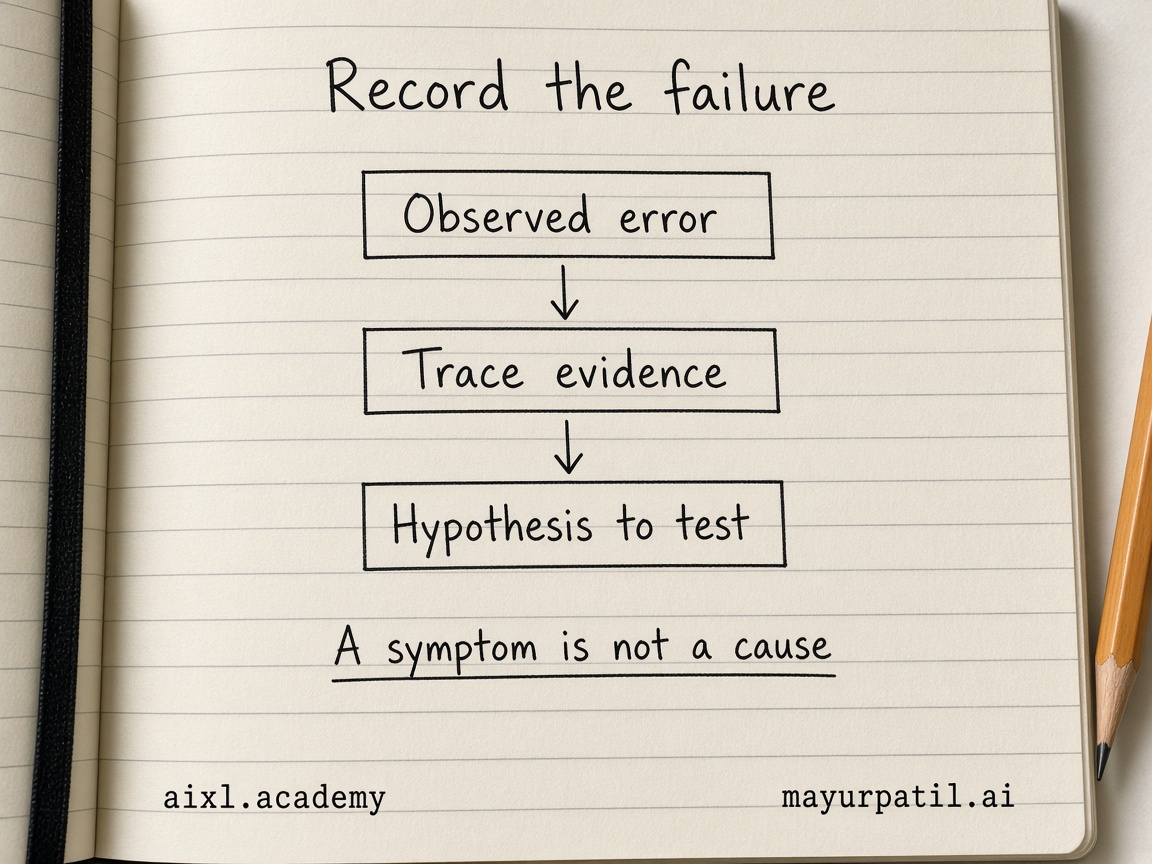
Before editing a prompt, I would ask for the exact claim that failed, the evidence that contradicts it and the point in the trace where the problem became observable. That is the job of error annotation: converting a reaction into a record that another person can inspect.
This is not about generating more labels. A useful annotation tells the team what is known, what remains uncertain and which experiment might resolve it.
Begin with the trace, not the verdict
Take a synthetic travel-policy assistant. The user asks whether a contractor can claim a taxi after a late shift. The fictional policy allows employees to claim under specified conditions but routes contractors to a separate process. The assistant says, "Yes, submit it through the employee claim form."
The response is wrong in this example. But there are several possible causes. Retrieval might have omitted the contractor appendix. The appendix might have arrived and been ignored. The source policy might itself be ambiguous. Those situations require different interventions.
An annotation should first capture the observable failure: the answer directed a contractor to a process the supplied policy reserves for employees. "Retrieval failure" is a hypothesis until the retrieved context is inspected.
Anthropic recommends reviewing transcripts precisely because scores alone do not show whether the problem lies in the agent, task or grader. Annotation makes that review reusable.
Use an evidence-first record
A practical record can be compact:
| Field | Synthetic example |
|---|---|
| Case | travel-contractor-01 |
| Criterion | Correct route for worker category |
| Observed behavior | Directed contractor to employee form |
| Evidence | Contractor appendix, paragraph B |
| Required behavior | Explain separate route or ask for missing category |
| Failure location | Final response |
| Causal hypothesis | Appendix retrieved but not applied |
| Confidence | Supported by visible context, not yet an intervention test |
| Severity | Material workflow error |
| Reviewer status | Independently reviewed, disagreement retained |
The example is fabricated for teaching. It is not a customer incident or a completed evaluation.
Preserve the original input and output by identifier in an appropriately controlled store. An annotation should not become a second uncontrolled copy of personal information. A reviewer can point to a protected trace without pasting every sensitive field into a shared issue.
Separate observation from explanation
Three sentences have different evidential strength:
"The output contains the wrong form identifier" is an observation.
"The contractor appendix was absent from the supplied context" is a trace-based finding.
"The chunking strategy caused the omission" is an explanation that needs more investigation.
Mixing them makes the next experiment unreliable. If an engineer treats an untested explanation as established fact, the fix can target the wrong component.
Record a plausible alternative. An empty retrieval result could reflect an access rule working correctly rather than broken search. A refusal could be the right behavior for the permissions in the case. Context changes the label.
Do not force certainty
Use explicit states such as insufficient evidence, ambiguous requirement and evaluator defect. They are not pass labels, but neither are they established model failures.
Suppose two reviewers disagree on whether the assistant should ask a clarifying question. One assumes the worker category is known from the session; the other sees only the final turn. Their disagreement may reveal a missing evaluation input rather than a difference in judgment.
Before adjudication, both reviewers should independently label the same evidence under the same criterion version. Keep those original labels. Store the adjudicated label separately with the reason for the change. Replacing the originals with a consensus label makes agreement look better than it was.
Agreement is also criterion-specific. Reviewers may consistently identify the wrong form but differ about tone. A single agreement score conceals that distinction. Inspect confusion pairs and critical disagreements, not only the aggregate.
Build a small calibration round
For a first pass, select a deliberately varied calibration batch: clear passes, clear failures, borderline cases and cases with missing evidence. The size is a planning choice, not a universal scientific minimum.
Ask reviewers to annotate independently. Compare labels and cited evidence. Resolve whether each disagreement reflects unclear wording, missing context, domain uncertainty or an honest difference in preference. Revise the guidance with positive and negative examples.
Then check the revised guidance on fresh cases. Agreement on the cases used to negotiate the rules shows the meeting produced consensus; it does not show that independent reviewers can apply the rules to unseen work.
OpenAI recommends multiple rounds of human review and examples for score levels. Anthropic similarly emphasizes clear criteria and calibration of model-based grading with humans. Neither removes the need for domain ownership when policy is genuinely unresolved.
Annotate successes too
Only reading failures can distort the picture. Review apparently successful outputs and a sample of routine traffic. A persuasive answer may have passed for the wrong reason, or a strict grader may have rejected a valid alternative.
In the synthetic contractor example, a refusal is not automatically a success. "I cannot help" avoids the wrong form but may still fail a requirement to explain the separate process. Annotation should capture that distinction rather than reward blanket refusal.
Keep output quality, policy compliance and task completion separate. A response can be correct but incomplete, or complete but unauthorized.
Turn the record into a testable next step
The annotation should end with an action that follows from the evidence. If the appendix was missing, test retrieval coverage. If it was present, test whether explicit worker-category handling changes the answer. If the policy is disputed, ask the policy owner to resolve it before changing the assistant.
Track whether the proposed intervention actually fixes the labeled behavior and whether it creates new errors. The annotation is not finished when someone assigns a category. It is useful when it improves the next decision.
For your next failure review, replace one vague complaint with an evidence-first record. That is a practical exercise to bring to an AI engineering review. AIXL Academy is the training destination if you want to explore the topic further.
A worked adjudication note
In the synthetic contractor case, imagine reviewer A marks wrong routing and reviewer B marks incomplete answer. Do not settle the difference by averaging labels. Ask whether both are describing different defects in the same response.
If the output names the employee form, wrong routing is directly supported. If it also omits the separate contractor process, incompleteness may be a valid secondary label. The adjudication can preserve both while choosing one primary diagnostic owner.
Now imagine reviewer B never received the contractor appendix. That is a different problem: the reviewers were not judging equivalent evidence. Repair the review packet and repeat the independent assessment where necessary. Record the earlier labels as superseded, not as proof of reviewer incompetence.
A useful adjudication note names the disputed criterion, evidence considered, final decision and any guidance change. It should also say whether the change affects other annotations. If the definition changed, check related cases rather than correcting only the one that triggered discussion.
Common questions
Should a model annotate all failures?
A model can propose labels. Validate it against independently reviewed cases before treating its labels as measurement.
Is disagreement a reason to discard a case?
Not automatically. It may expose a missing requirement or missing evidence. Retain it and record the resolution.
Must every error have a root cause?
No. A supported observation is more useful than a confident but invented cause. Mark the cause as unknown until evidence supports it.