Hill climbing without teaching to the eval
Improving an eval score is easy if the team is allowed to keep changing the exam. Improving the product is harder.
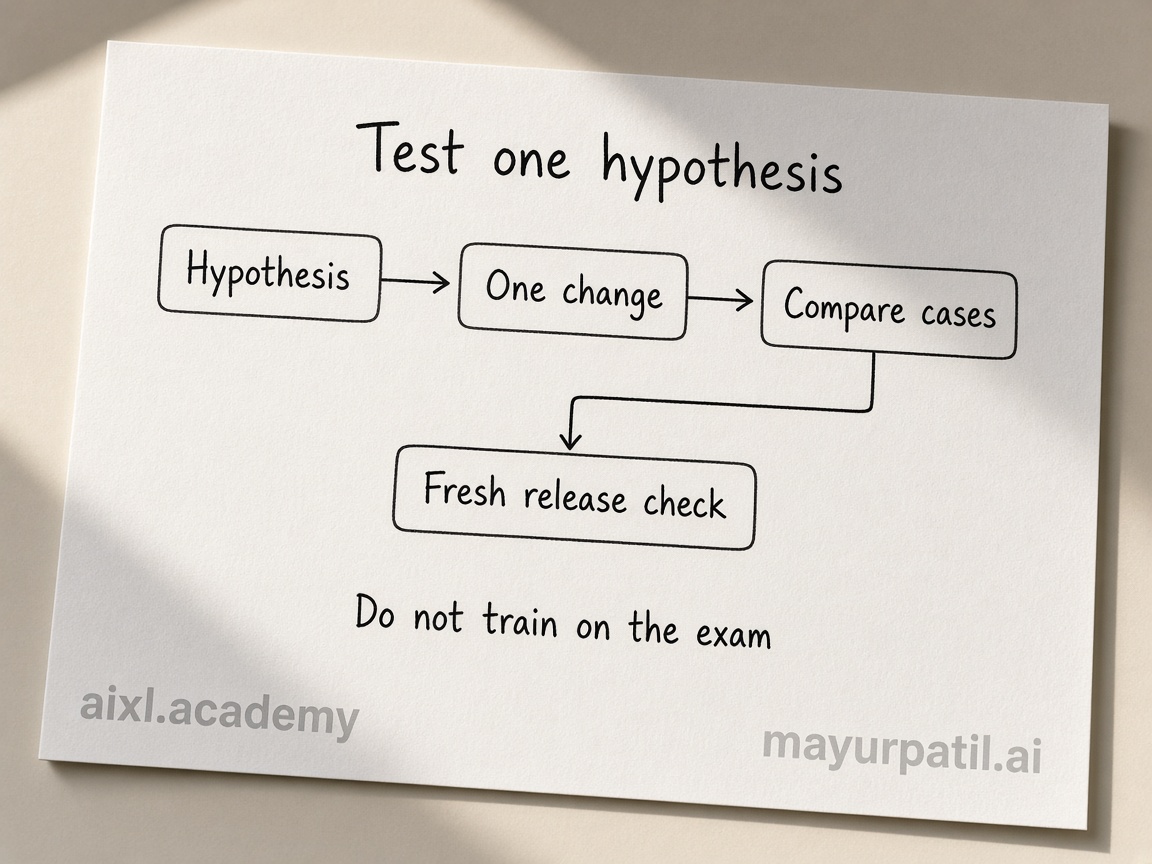
I use "hill climbing" here to mean iterative improvement against a defined objective: inspect failures, propose a change, compare it with the baseline and keep it only when the evidence supports the intended improvement.
The danger is confusing a better development score with better performance on work the team has not already studied.
Choose the hill before the climb
For a synthetic policy assistant, the objective could be more supported, useful answers without crossing authorization boundaries. Latency and operating cost matter too, but they do not cancel a critical disclosure failure.
Write the release gates and trade-offs before comparing candidates. If every candidate gets a new definition of success, the score history stops describing progress.
Anthropic distinguishes capability suites, which expose room for improvement, from regression suites, which protect behavior already achieved. That distinction is useful. A challenge set can provide a direction to improve, while the regression set checks that the change did not damage established behavior.
Neither replaces a genuinely held-out assessment of generalization.
Turn a category into a hypothesis
Suppose annotated development failures show that the assistant often misses a contractor appendix. The hypothesis might be: a document filter excludes an approved appendix, so correcting the filter will improve contractor routing.
That is more specific than "the model needs a better prompt". It identifies a mechanism, a proposed intervention and a predicted result. The evidence could still disprove it.
Keep the first experiment narrow where practical. Change the filter while holding the model and answer prompt fixed. Run the same development cases and inspect the retrieved evidence. If the appendix is now present but the answer remains wrong, the experiment has narrowed the diagnosis even if the score did not rise.
A failed hypothesis can be progress. A collection of simultaneous edits with an unexplained score change is harder to learn from.
Compare cases, not only totals
A candidate can fix several failures and break the same number of previous successes. The total stays flat while the product changes materially.
Review fixed cases, new failures, unchanged failures and cases the grader could not decide. Segment by failure family and user-relevant slice. Preserve the outputs and versions needed to replay the comparison.
Run baseline and candidate under equivalent conditions. Reset mutable state. If an environment outage affects one run, report it and investigate rather than silently treating it as a model-quality result.
Because model behavior varies, a single trial may not be a stable estimate. Anthropic discusses repeated trials and the difference between at least one successful attempt and consistent success across attempts. Choose the policy that matches the user experience. A product that offers one response should not advertise best-of-many performance as first-attempt reliability.
Keep the holdout genuinely held out
Development cases are meant to influence choices. Release holdouts are not.
If someone reads a holdout failure, rewrites the prompt around it and reruns until it passes, the case has become development material. That is not forbidden. It simply changes what the next score can claim.
Record that promotion. Preserve an untouched or newly collected release set for the next generalization estimate. Do not call an exposed set independent because the file was copied into another folder.
Repeatedly selecting a candidate from holdout scores also leaks information, even without reading every answer. Limit release-set access and define when it is used. The exact governance depends on the risk and iteration rate.
The scikit-learn documentation warns against using test data for model choices. Applying that principle to prompt, retrieval and judge tuning is a useful safeguard for AI product development too.
Watch for proxy optimization
A rubric that rewards citations can encourage citations that do not support the claim. A rubric that rewards completeness can encourage long, irrelevant answers. A rubric that rewards caution can encourage unnecessary refusals.
Include counterexamples that make those shortcuts fail. Check citation support, not citation count. Check required facts, not length. Test cases where answering is required as well as cases where escalation is appropriate.
Do not rewrite the grader just to make a favored candidate win. If a grader defect is discovered, fix it, version it and rescore both baseline and candidate. Keep the earlier result with an explanation of why it was superseded.
Make uncertainty visible
A small score improvement on a small, variable set may not support a confident release decision. Report uncertainty rather than adding decimal places.
Choose analysis that respects the data structure. Repeated attempts on one case are not equivalent to independent cases from different users. Requests from the same incident may also share dependencies. Seek statistical review for consequential claims rather than treating every row as an independent observation.
A release can still be justified under uncertainty if the scope is narrow and controls are appropriate. What matters is that the uncertainty is part of the decision, not hidden behind a total.
Graduate cautiously
When the candidate clears the agreed offline gates, test the actual workflow under approved operational controls. Shadow evaluation can reveal behavior without allowing autonomous action. A limited rollout needs owners, monitoring and rollback criteria.
Offline evaluation is one layer. Anthropic explicitly places it alongside production monitoring, user feedback, human review and other methods. No single score substitutes for all of them.
For your next iteration, write one falsifiable hypothesis and one regression risk before editing anything. If you want to explore the engineering approach behind that discipline, see AIXL Academy.
Keep a stopping rule for the iteration
Before trying variants, decide what evidence would justify continuing, stopping or changing direction. Otherwise the team can keep sampling candidates until a favorable fluctuation appears and then remember that candidate as a clear improvement.
For the synthetic retrieval experiment, a stopping condition might be that the appendix is consistently supplied on the targeted development cases, routing still fails and the new evidence points to interpretation rather than filtering. That result suggests changing the hypothesis, not endlessly tuning the same filter.
Keep an experiment table with the intended mechanism, changed components, run identifiers, case-level transitions and decision. Record rejected variants too. If several settings move together, say that the comparison identifies a bundle rather than the effect of any one setting.
When the objective changes, open a new comparison rather than rewriting the history of the old one. A latency optimization and a correctness optimization can both be worthwhile, but they answer different questions. The release owner should see the trade-off explicitly.
The stopping rule is also a protection against overfitting the development set. An exhausted challenge set can remain a useful regression check while the team collects fresh examples that expose the next limitation.
Common questions
Can a holdout failure become a regression test?
Yes. Once inspected and used for development, record the role change and stop treating it as untouched evidence.
Must every experiment change only one variable?
No, but narrow experiments are easier to interpret. For bundled changes, state that attribution is limited and use follow-up comparisons when needed.
Is a higher average enough to ship?
No. Check critical gates, new regressions, relevant slices, uncertainty and the conditions of the intended rollout.